
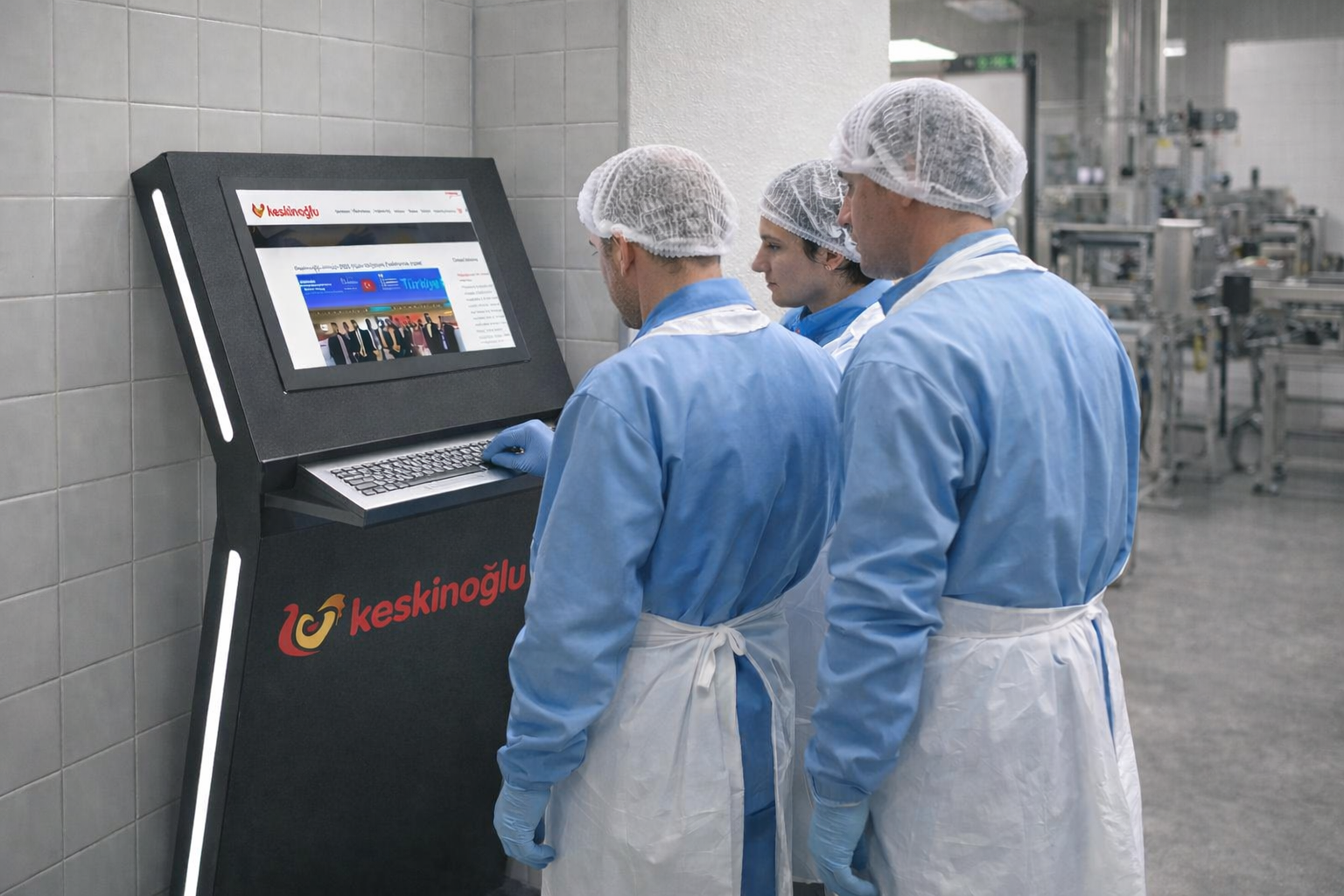
Why Is Kiosk Usage for Human Resources in Factories Becoming More Widespread?
In this article, we examine the key reasons behind the increasing demand for kiosk systems in factory environments.
Factory environments differ significantly from traditional office settings. Most employees do not work at desks, and many do not have corporate computers or email addresses. Therefore, they need a practical and secure way to communicate requests, complaints, and suggestions directly to the Human Resources (HR) department or management.
When considering the hesitation employees may feel when expressing complaints face-to-face with a supervisor, it becomes clear why kiosk systems are becoming widespread. Kiosks help build a transparent and healthy communication culture within factories by enabling anonymous or structured feedback processes.
Additionally, kiosks provide personalized HR services by reading employee cards. For example:
• Viewing and printing payroll and salary information
• Leave request and tracking processes
• Attendance and shift tracking
• Training and mandatory documentation processes (occupational safety training videos, data protection consents, policy and procedure approvals)
All these processes can be completed through the kiosk using digital signatures.
Furthermore, survey and feedback applications allow employees to evaluate cafeteria services, transportation services, and overall satisfaction levels.
These services significantly reduce the operational workload of HR departments while increasing employee satisfaction. At the same time, management gains measurable and analyzable insights into employee expectations and feedback.
Factory-Optimized Models: NX400 and NX500
When selecting kiosk models for factory environments, the most critical criteria are durability, environmental compatibility, and long-term operational performance. In this context, NX400 and NX500 stand out as two powerful solutions frequently preferred in manufacturing facilities.
NX400 features a cataphoresis-coated steel body and an IP65-rated industrial keyboard, making it ideal for environments with high humidity, heat, and dust levels. The IP65 protection rating ensures full dust protection and resistance against low-pressure water exposure. It is particularly suitable for heavy industry, foundries, textile production areas, and logistics warehouses.
NX500, on the other hand, offers an IP30 protection rating and serves as a cost-effective alternative for controlled indoor factory areas that are not exposed to heavy dust or moisture. It is well-suited for HR office spaces, cafeteria entrances, personnel transition points, and administrative sections.
Both models are optimized for HR processes, employee feedback systems, shift tracking, and digital documentation workflows. However, selecting the appropriate model requires careful evaluation of environmental conditions to ensure optimized investment and long-term operational sustainability.